He blamed the hill. Then the shopping bags. The scan showed an artery hardened “like concrete.”


He was 54, played golf most weekends and had never smoked. Heart trouble ran through his family, but he had always been able to explain that away. His father and uncles had not exactly looked after themselves.
Then, walking up towards the seventh hole with his son, he felt a tightness across his chest. Not agony. Not the cinematic clutch-and-collapse people imagine. Just enough to make him slow down.
He blamed the hill and finished the round.
A few weeks later it happened again while he was carrying the shopping in. This time there was no hill to blame. After months of pressure from his wife, he booked an appointment with his doctor.
He did not drive home that day. They did not let him.
The procedure dealt with what had become urgent.
It did not answer how it had been building so quietly.
The warnings were ordinary. That was the problem.
Nothing in the months before the scan felt big enough to rearrange his life around. Each warning arrived with a perfectly reasonable excuse attached.
“I am not as fit as I used to be.” Golf carried on as normal.
“I carried too much in one trip.” He put them down and the feeling passed.
“They lived differently.” A real risk became somebody else’s story.
“I feel fine most of the time.” Fine became permission to wait.
That is what made the scan so hard to square with the man looking at it. The artery was not merely narrowed. Years of plaque had calcified until part of the vessel had become rigid — closer to bone than the soft tissue it had once been.

A normal stent could not get through it.
The consultant used the word “concrete.” The calcium was too hard for the usual fix, so the team proposed something most people never hear about until they need it: rotational atherectomy.
A catheter would enter through the artery in his wrist. At its tip sat a tiny diamond-coated burr. Spinning at up to 190,000 revolutions per minute, it could ablate the hardened calcium and create a path for the balloon and stent that followed.*6–7

He lay beneath the lights and heard the machine before he understood what he was hearing: a high, distant whir from somewhere inside his own chest. Not sharp pain. Pressure. The strange sensation of a mistake made slowly over years being corrected in minutes.
When it was over, the stent was in place. The emergency had been handled.
A diamond-tipped burr can create room in minutes. The buildup that makes it necessary develops quietly over years.
New or unexplained chest pain needs urgent medical attention. A dietary supplement is not an emergency treatment or a replacement for prescribed care.
The procedure answered the emergency. It did not answer the question.
Four days into his recovery, he started reading. What causes plaque to harden? How long can it build without announcing itself? And what, if anything, had researchers measured before an emergency procedure became necessary?
One headline stopped him. It described a Japanese enzyme being studied for artery plaque. He nearly dismissed it as another “secret” imported from somewhere far away.
Then he looked at the human data.

The Japanese clue began in a petri dish.
In 1980, researcher Dr. Hiroyuki Sumi placed natto onto a blood clot in a laboratory dish. Within six hours, the clot had broken apart.
The active enzyme was not present in ordinary soy. It was created during fermentation. Sumi named it nattokinase.
To understand why that mattered, you need one protein: fibrin. Fibrin is the temporary mesh your body lays down to hold a clot together. Once the repair is complete, your fibrinolytic system helps take that scaffolding back down. A review of hemostasis and ageing reports that this clean-up activity can become impaired with age.*2
The burr is an emergency mechanical procedure. Nattokinase is an enzyme researchers have studied over weeks, months and years for changes in plaque measurements, blood pressure and fibrin-related markers. Different intervention. Different timescale. Different evidence.
The study that turned a strange headline into a serious question
Researchers reviewed 1,062 clinical records covering a full year of nattokinase use. Among the 683 people with carotid measurements, the reported average plaque area was 36% lower after 12 months; artery-wall thickness was 21.7% lower. Average LDL was 18.1% lower across the wider group.*5
After one year, plaque area, artery-wall thickness and LDL were lower

The time matters: these were measurements recorded over 12 months, not a fleeting change in a laboratory marker.
One detail worth keeping straight: most records used 10,800 FU per day; NF delivers 5,000 FU. Treat 36% as the study result, not a guarantee. What the study establishes is that plaque measurements were recorded in humans over a full year.
Two shorter human studies asked different questions.
The year-long record review put plaque first. Two shorter studies looked at other parts of the circulation picture: blood pressure and three proteins involved in clot formation.
Blood pressure fell further than with placebo

This was the cleanest comparison: nattokinase against a matching placebo. After eight weeks, the difference between the groups favored nattokinase for both systolic and diastolic pressure.
Three clotting factors declined across all three groups

Fibrinogen, factor VII and factor VIII declined over eight weeks in healthy adults, people with cardiovascular risk factors and dialysis patients. It was a small study without a placebo group, but the direction repeated across all three groups.
Then 29,079 people supplied the long view.
The largest population study in this story followed 29,079 adults in Takayama City for 16 years, matching what they ate against later health outcomes.

Compared with the people who ate the least natto, those eating the most had a 25% lower risk of cardiovascular death and a 33% lower risk of ischemic-stroke death.*1
The researchers checked tofu, soy milk, total soy protein and total isoflavones. None showed a significant association. Only natto did.
That does not prove natto caused the difference. It was an observational food study, not a supplement trial. But it supplied a 16-year clue that pointed in the same direction as the shorter human enzyme studies.
One unusual enzyme. Four human data sets. Several different measurements. None of them turns a supplement into emergency medicine. Together, they make nattokinase a serious category to compare — and that comparison begins with the number on the label.
The number most nattokinase labels would rather you didn't compare
Nattokinase isn't measured in milligrams. It's measured in fibrinolytic units — FU — because what matters isn't how much powder is in the capsule, it's how much enzyme activity that powder has. Two capsules can weigh exactly the same and deliver completely different amounts of the thing you're paying for.
A widely sold dose is 2,000 FU per capsule. Lower activity costs less to produce, which is why it's common. Ours is 5,000 FU.
Do the arithmetic on that. To match one of our capsules you'd take two and a half of the 2,000 FU sort — so a 30-capsule bottle lasts twelve days, and matching our 90-day supply takes seven and a half bottles.
FU measures active enzyme strength — not simply how much powder is in the capsule. That makes it the number you can use to compare nattokinase products like for like. With 5,000 FU per capsule, you know exactly what you're paying for.
What's in it, and what we can prove
- Nattokinase, 5,000 FU per capsule. One capsule daily. 30 capsules per bottle, so a bottle is a month.
- Every batch third-party tested. Not the first batch, not a sample — every one. The number on the label is a number a lab outside this company confirmed.
- Manufactured in-house under GMP conditions. We control the process rather than buying finished capsules and applying a label.
- 712,000+ bottles sold. This isn't a new product looking for its first customers.
We sent eight competitors to a lab
Claiming a number on a label is free. So in 2025 we bought eight leading US nattokinase brands off the shelf and sent them to SORA Laboratories for the standard GM0068 enzyme activity assay — the test that measures whether the FU on the bottle is actually in the capsule.
Six of the eight failed. The capsules contained nowhere near the activity printed on the label.

That is the real reason the FU number matters, and it's why we publish ours rather than asking you to take it on trust. Every batch we make is tested at ISO/IEC 17025 accredited labs — SORA and Eurofins — and every certificate of analysis is public.
Join 121,023+ Americans Supporting Heart Health Naturally
Real customers. Real results. Independently verified reviews.


Now non-hypertensive. I have been using the supplement for 33 days. My doctor has just confirmed I am now non-hypertensive.
It works. Down from 145/94 to 125/82 on average.
I can genuinely feel the benefits. At 59 years old I had growing concerns about my arterial health. I am only three weeks in and my breathing is better, I'm feeling more awake and I cannot recommend Nattokinase enough!
Incredibly impressed by the results. My blood pressure was on average 155/95 and my latest reading was 119/75. I found Natural Foundation and I have to say I'm incredibly impressed.
A customer for about 4 months. My blood pressure has come right down so I will keep taking it.
Recommend to all my patients. Been on Nattokinase for several months. I like it and recommend to all my patients and family. I am a physician in practice.
BP is definitely sorting itself out. Started taking the tablets about 3 weeks ago and my blood pressure is definitely sorting itself out — steady and a lot lower which is a big relief.
Outstanding. I've noticed a change in my circulation. It feels a lot different for the better.
Individual results vary. These are individual customer experiences and are not a statement of typical results.
Healthy Blood Flow,
Pressure & Circulation —
Buy 2, Get 1 FREE + Free Shipping
America's most rigorously tested Nattokinase. 5,000 FU per capsule. Manufactured in-house in our GMP-certified UK facility. Every batch tested by ISO/IEC 17025 accredited labs.
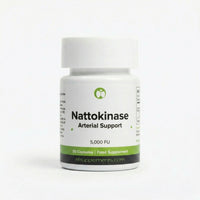

Try it for a full 90 days. If you don't feel a difference, we'll refund every cent — even empty bottles.
Try it for 90 days—without risking a dollar
Nattokinase isn't something you should judge after a handful of capsules. That's why every order is protected for a full 90 days from delivery.
- Use it consistently for up to 90 days. Give yourself enough time to make a fair decision.
- Empty bottles are still covered. Finish every bottle you receive and the guarantee still applies.
- No restocking fees or return shipping. There is nothing to send back.
- One email is all it takes. Just email us with your order number.
If you're not satisfied, email us within 90 days of delivery and we'll refund every cent.
Your questions, answered
If you have a question we haven't answered, our team is one email away.
What exactly is Nattokinase, and why 5,000 FU?
Nattokinase is a fibrinolytic enzyme extracted from natto — fermented Japanese soybeans. “FU” stands for Fibrinolytic Units, the standard measure of enzymatic activity. Most US brands sell 2,000 FU per capsule because it's cheaper to produce. Our 5,000 FU dose matches the level used in the majority of published clinical research on Nattokinase — so you're not guessing whether your dose is high enough to actually do anything. Take one capsule a day.
How is NF different from cheaper brands on Amazon?
Three things: (1) Per-batch third-party testing at ISO/IEC 17025 accredited labs (SORA Labs and Eurofins). Every certificate of analysis is public at testing.nfsupplements.co.uk. (2) In-house GMP manufacturing in our UK facility — not outsourced. (3) We removed Vitamin K2, magnesium stearate, and titanium dioxide that contaminate most other nattokinase products. Most US brands fail the basic GM0068 enzyme activity assay. We don't.
Can I take it with blood thinners or blood pressure medication?
Speak to your doctor first. Nattokinase has natural fibrinolytic activity, so combining it with prescription anticoagulants (Warfarin, Eliquis, Xarelto) or antiplatelets (clopidogrel, daily aspirin) requires medical supervision. Many doctors are familiar with Nattokinase and can advise on dosing. If you're scheduled for surgery, stop taking it 14 days prior.
When will I notice a difference?
Most customers report feeling subtle benefits in the first 1–2 weeks (lighter legs, less afternoon fatigue, improved sleep). Measurable changes — blood pressure readings, resting heart rate — typically show up between weeks 3 and 6 of consistent daily use. That's why we recommend a minimum 30-day commitment, and why our guarantee runs a full 90 days.
Is Nattokinase safe for long-term use?
Yes. Nattokinase has been consumed in Japan as part of natto for over 1,000 years, and modern clinical use spans 45 years. The most-cited long-term safety studies follow daily users for 6+ months with no significant adverse events reported. For maintenance, we recommend dropping to 1 capsule, 5 days per week once you've reached your goal.
How does the Buy 2, Get 1 Free offer work?
Select the 3-bottle subscription and we automatically include a third bottle free, with free US shipping. That's 3 bottles for $99.99 every 90 days — a 90-day supply at $33.33 per bottle, saving you $19.98 versus buying 3 single bottles separately (plus $29.97 in shipping you'd otherwise pay). The subscription renews automatically every 90 days until cancelled. Contact help@naturalfsupplements.com before your next renewal to cancel. The free 1-month Circulation Support is added to your first 3-bottle order.
Where is it made, and where does it ship from?
NF Nattokinase is manufactured in our own GMP-certified facility in Oxford, England. We control every step — from raw ingredient testing to final encapsulation — which is why we can publish a real COA for every batch. We ship from a US warehouse for fast 2–5 day delivery to all 50 states, with import duties and taxes prepaid.
What if it doesn't work for me?
Then we refund you. Email us within 90 days of delivery, with your order number, and we'll process a full refund — even if the bottles are empty. No restocking fees, no return shipping, no questions. We can afford this guarantee because over 92% of customers keep ordering.
 Recommended by Dr. Karen Vieira, PhD
BUNDLE BONUS