A Japanese scientist dropped his breakfast onto a blood clot. Six hours later, the clot had broken apart.

Most people think of circulation as a heart problem.
It's mostly a plumbing problem — and the plumbing is held together by a protein you've probably never heard of.

That protein is called fibrin, and you need it. It's the mesh your body builds to stop a cut bleeding — long strands that criss-cross, lock together and hold a clot in place. Useful, temporary scaffolding.
Your body also runs a system for taking that scaffolding back down once the job is done. It's called fibrinolysis, and it runs quietly in the background, every hour of every day.
It slows with age. Not dramatically, not overnight — but the balance between laying scaffolding down and clearing it away shifts, gradually, in one direction. A review of hemostasis and ageing puts it plainly: “Fibrinolysis activity is impaired in the elderly, particularly due to an increase in plasminogen activator inhibitor 1 (PAI-1) levels.”*2 PAI-1 is the brake on the system that clears fibrin away, and it rises as you get older.

What Dr. Sumi actually found
In 1980 a Japanese researcher named Dr. Hiroyuki Sumi was working with natto in a lab. The story, as it has been told since, is close to accidental: he placed some onto a dish containing a blood clot and expected very little.
Within six hours, the clot had broken apart.
What he'd found wasn't in the soybeans. It was made by the bacteria during fermentation — an enzyme he named nattokinase, after the food that produced it. It's what's known as a fibrinolytic enzyme: it acts on fibrin. On the scaffolding, not the blood.

Is this you?
Nobody arrives at nattokinase casually. In our experience people get here from one of a handful of places.
🩺 The number that moved
Something came back higher than last time. Your doctor said "let's watch it" and booked you in for nine months' time. You left with nothing to do in the meantime.
👨👩👦 The family history
A parent or sibling had something happen in their fifties or sixties. You've been aware of it ever since, in the back of your mind.
🧊 The cold hands
Your hands and feet are cold when nobody else's are. You've been told you "just run cold" and never quite believed it.
✈️ The long-haul sitter
Long flights, long drives, desk-bound days. You've read enough about sitting still for hours to have thought about it.
🇯🇵 The Japan question
You read something about Japanese longevity and the diet behind it, and wondered which part actually mattered.
💊 The label reader
You already take things. You've started turning bottles over and comparing the numbers on the back, and you've noticed they don't match up.
If one of these sounds familiar, you're in the right place. The next question is whether the research gives you a reason to keep reading. So let's start with the largest study.
29,079 people. Sixteen years.
Japan sits near the top of the world for life expectancy, and an enormous amount of research has gone into asking why. Natto has been studied specifically.
The largest single effort followed 29,079 adults in Takayama City — 13,355 men and 15,724 women — for 16 years, matching what they ate against what they eventually died of.

The people who ate the most natto had a 25% lower risk of death from cardiovascular disease than those who ate the least, and a 33% lower risk of death from ischemic stroke.*1
But the number that makes this study worth reading isn't either of those.
The same researchers measured every other source of soy in these diets — tofu, soy milk, total soy protein, total isoflavones. None showed a significant association. Only natto did.
That's the finding that points at the enzyme rather than at soy. If the benefit came from soy generally, tofu would have shown it too. It didn't — and the paper's authors name the obvious candidate: natto contains a potent fibrinolytic enzyme.
This was an observational food study, so it found an association — not cause and effect. But across 29,079 people and 16 years, natto was the only soy food linked with better outcomes. That was the clue researchers then took into human studies of the enzyme itself.
Natto was the clue. Then researchers put the enzyme to the test.
The food study opened the door. These three human studies then looked at nattokinase itself — from an eight-week placebo-controlled trial to a full year of clinical records.
Blood pressure fell further than with placebo

This was the cleanest comparison of the three: nattokinase against a matching placebo. After eight weeks, the difference between the groups favoured nattokinase for both systolic and diastolic pressure.
But blood pressure is only one part of the circulation picture. Another study looked at three proteins involved in clot formation.
Three clotting factors declined across all three groups

The same direction of change appeared in healthy adults, people with cardiovascular risk factors and dialysis patients: fibrinogen, factor VII and factor VIII all declined over eight weeks. It was a smaller open-label study, but the pattern appeared across all three groups.
That raised the longer-term question: were researchers seeing only short-term blood-marker changes — or changes they could measure in the arteries themselves?
Plaque area, artery-wall thickness and LDL were lower after one year

A year of clinical records supplied a different kind of evidence. Among participants with carotid measurements, plaque area and artery-wall thickness were lower after 12 months; LDL cholesterol was lower across the wider study group.
This was retrospective rather than randomized, and the dose was higher than NF's. What it adds is time: these changes were recorded over a full year, not a handful of weeks.
vs. placebo
vs. placebo
Blood pressure fell further than with placebo.
Three clotting factors declined across all three groups.
plaque area
thickness
cholesterol
Plaque area, artery-wall thickness and LDL were lower after one year.
Three studies. Three doses. Three different measurements. And one question any serious nattokinase buyer should ask next: how much active enzyme is actually in the capsule? Full study details and links are in the references.
The number most nattokinase labels would rather you didn't compare
Nattokinase isn't measured in milligrams. It's measured in fibrinolytic units — FU — because what matters isn't how much powder is in the capsule, it's how much enzyme activity that powder has. Two capsules can weigh exactly the same and deliver completely different amounts of the thing you're paying for.
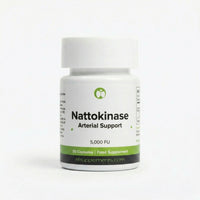
A widely sold dose is 2,000 FU per capsule. Lower activity costs less to produce, which is why it's common. Ours is 5,000 FU.
Do the arithmetic on that. To match one of our capsules you'd take two and a half of the 2,000 FU sort — so a 30-capsule bottle lasts twelve days, and matching our 90-day supply takes seven and a half bottles.
FU measures active enzyme strength — not simply how much powder is in the capsule. That makes it the number you can use to compare nattokinase products like for like. With 5,000 FU per capsule, you know exactly what you're paying for.
What's in it, and what we can prove
- Nattokinase, 5,000 FU per capsule. One capsule daily. 30 capsules per bottle, so a bottle is a month.
- Every batch third-party tested. Not the first batch, not a sample — every one. The number on the label is a number a lab outside this company confirmed.
- Manufactured in-house under GMP conditions. We control the process rather than buying finished capsules and applying a label.
- 712,000+ bottles sold. This isn't a new product looking for its first customers.
We sent eight competitors to a lab
Claiming a number on a label is free. So in 2025 we bought eight leading US nattokinase brands off the shelf and sent them to SORA Laboratories for the standard GM0068 enzyme activity assay — the test that measures whether the FU on the bottle is actually in the capsule.
Six of the eight failed. The capsules contained nowhere near the activity printed on the label.

That is the real reason the FU number matters, and it's why we publish ours rather than asking you to take it on trust. Every batch we make is tested at ISO/IEC 17025 accredited labs — SORA and Eurofins — and every certificate of analysis is public.
Join 121,023+ Americans Supporting Heart Health Naturally
Real customers. Real results. Independently verified reviews.


Now non-hypertensive. I have been using the supplement for 33 days. My doctor has just confirmed I am now non-hypertensive.
It works. Down from 145/94 to 125/82 on average.
I can genuinely feel the benefits. At 59 years old I had growing concerns about my arterial health. I am only three weeks in and my breathing is better, I'm feeling more awake and I cannot recommend Nattokinase enough!
Incredibly impressed by the results. My blood pressure was on average 155/95 and my latest reading was 119/75. I found Natural Foundation and I have to say I'm incredibly impressed.
A customer for about 4 months. My blood pressure has come right down so I will keep taking it.
Recommend to all my patients. Been on Nattokinase for several months. I like it and recommend to all my patients and family. I am a physician in practice.
BP is definitely sorting itself out. Started taking the tablets about 3 weeks ago and my blood pressure is definitely sorting itself out — steady and a lot lower which is a big relief.
Outstanding. I've noticed a change in my circulation. It feels a lot different for the better.
Individual results vary. These are individual customer experiences and are not a statement of typical results.
Healthy Blood Flow,
Pressure & Circulation —
Buy 2, Get 1 FREE + Free Shipping
America's most rigorously tested Nattokinase. 5,000 FU per capsule. Manufactured in-house in our GMP-certified UK facility. Every batch tested by ISO/IEC 17025 accredited labs.

Try it for a full 90 days. If you don't feel a difference, we'll refund every cent — even empty bottles.
Try it for 90 days—without risking a dollar
Nattokinase isn't something you should judge after a handful of capsules. That's why every order is protected for a full 90 days from delivery.
- Use it consistently for up to 90 days. Give yourself enough time to make a fair decision.
- Empty bottles are still covered. Finish every bottle you receive and the guarantee still applies.
- No restocking fees or return shipping. There is nothing to send back.
- One email is all it takes. Just email us with your order number.
If you're not satisfied, email us within 90 days of delivery and we'll refund every cent.
Your questions, answered
If you have a question we haven't answered, our team is one email away.
What exactly is Nattokinase, and why 5,000 FU?
Nattokinase is a fibrinolytic enzyme extracted from natto — fermented Japanese soybeans. “FU” stands for Fibrinolytic Units, the standard measure of enzymatic activity. Most US brands sell 2,000 FU per capsule because it's cheaper to produce. Our 5,000 FU dose matches the level used in the majority of published clinical research on Nattokinase — so you're not guessing whether your dose is high enough to actually do anything. Take one capsule a day.
How is NF different from cheaper brands on Amazon?
Three things: (1) Per-batch third-party testing at ISO/IEC 17025 accredited labs (SORA Labs and Eurofins). Every certificate of analysis is public at testing.nfsupplements.co.uk. (2) In-house GMP manufacturing in our UK facility — not outsourced. (3) We removed Vitamin K2, magnesium stearate, and titanium dioxide that contaminate most other nattokinase products. Most US brands fail the basic GM0068 enzyme activity assay. We don't.
Can I take it with blood thinners or blood pressure medication?
Speak to your doctor first. Nattokinase has natural fibrinolytic activity, so combining it with prescription anticoagulants (Warfarin, Eliquis, Xarelto) or antiplatelets (clopidogrel, daily aspirin) requires medical supervision. Many doctors are familiar with Nattokinase and can advise on dosing. If you're scheduled for surgery, stop taking it 14 days prior.
When will I notice a difference?
Most customers report feeling subtle benefits in the first 1–2 weeks (lighter legs, less afternoon fatigue, improved sleep). Measurable changes — blood pressure readings, resting heart rate — typically show up between weeks 3 and 6 of consistent daily use. That's why we recommend a minimum 30-day commitment, and why our guarantee runs a full 90 days.
Is Nattokinase safe for long-term use?
Yes. Nattokinase has been consumed in Japan as part of natto for over 1,000 years, and modern clinical use spans 45 years. The most-cited long-term safety studies follow daily users for 6+ months with no significant adverse events reported. For maintenance, we recommend dropping to 1 capsule, 5 days per week once you've reached your goal.
How does the Buy 2, Get 1 Free offer work?
Select the 3-bottle subscription and we automatically include a third bottle free, with free US shipping. That's 3 bottles for $99.99 every 90 days — a 90-day supply at $33.33 per bottle, saving you $19.98 versus buying 3 single bottles separately (plus $29.97 in shipping you'd otherwise pay). The subscription renews automatically every 90 days until cancelled. Contact help@naturalfsupplements.com before your next renewal to cancel. The free 1-month Circulation Support is added to your first 3-bottle order.
Where is it made, and where does it ship from?
NF Nattokinase is manufactured in our own GMP-certified facility in Oxford, England. We control every step — from raw ingredient testing to final encapsulation — which is why we can publish a real COA for every batch. We ship from a US warehouse for fast 2–5 day delivery to all 50 states, with import duties and taxes prepaid.
What if it doesn't work for me?
Then we refund you. Email us within 90 days of delivery, with your order number, and we'll process a full refund — even if the bottles are empty. No restocking fees, no return shipping, no questions. We can afford this guarantee because over 92% of customers keep ordering.
 Recommended by Dr. Karen Vieira, PhD
BUNDLE BONUS