

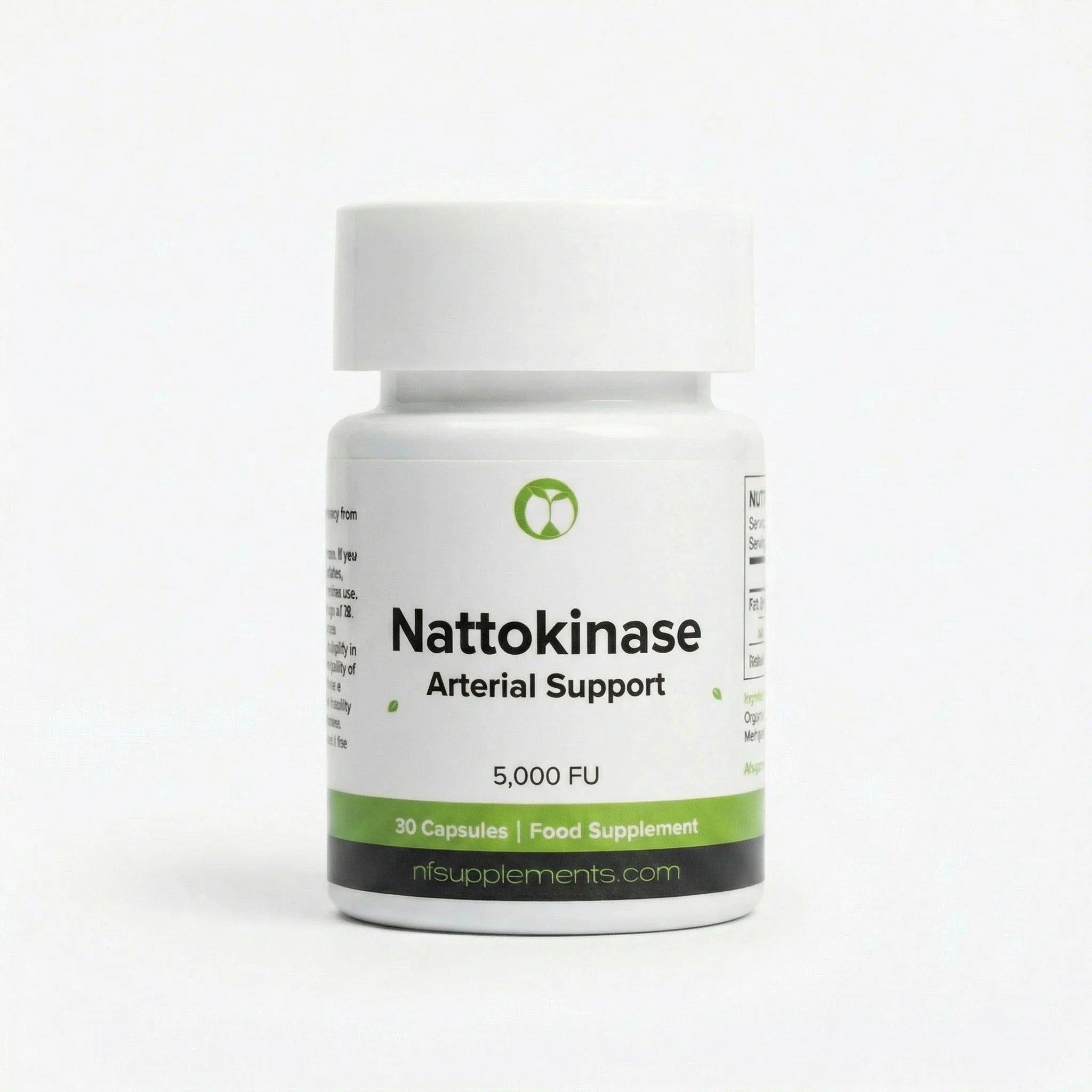
Case 01
NattokinaseUK market sample
6 of 8 brands tested failed their label claim. One product returned 17.8% of the stated fibrinolytic units.

Welcome to NF Supplements. Every bottle that leaves our facility carries a batch number — and behind that batch number sits an independent laboratory report we paid for, didn't write, and can't edit. We publish all of them, in full, at testing.nfsupplements.co.uk.
The standard we hold ourselves to is straightforward. Every batch goes to an independent ISO/IEC 17025 accredited laboratory. The Certificate of Analysis it returns is uploaded to our public testing database, unredacted, indexed by the batch number on the bottle in your hand. Nothing summarised. Nothing curated. The PDF the lab issues is the PDF you see.
We can do this because we manufacture in-house. Our GMP-certified facility in Kidlington, Oxford means every step from raw material intake to encapsulation runs under one roof and one quality system — no contract manufacturer in the loop, no quiet conversations with a supplier when a result doesn't come back clean. When a batch falls outside specification it is held, reworked, or destroyed. We have rejected our own production on this basis.
Every batch. Every test. Published in full. That's the standard. What follows on this page is how the system actually works — the labs we use, the assays we run, the chain of custody from our facility to the certificate on your screen, and how you can verify the bottle in your hand against the lab report behind it.
Whenever a supplier ships us a raw ingredient, it arrives with a Certificate of Analysis from an independent third-party lab. This confirms the material that turned up at our facility is the material we ordered, at the quality we paid for. Wrong species, wrong potency, wrong anything — it doesn't make it past goods-in. The batch doesn't get made.
After the capsules are made, filled into bottles and packed, we pull one or two finished bottles directly off the packing line — one for smaller runs, two for larger batch sizes — and send them ourselves to an independent ISO/IEC 17025 accredited laboratory. The lab tests the actual product — the same physical capsules that go into the boxes you receive. This is the test that confirms the manufacturing process did its job: that enough of the active ingredient made it into the capsule, that nothing was lost between raw material and finished bottle.
That Certificate of Analysis is then uploaded — in full, unredacted — to our public testing database, indexed by the batch number printed on the lid. When you scan the QR (or type the batch number into the archive), you're not looking at a certificate for "a similar product." You're looking at the test result for a bottle that came off the same packing line as yours, on the same day, from the same raw material. The same batch.
Confirms the actual quantity of the active compound per capsule against the label claim. For Nattokinase this is reported in fibrinolytic units (FU); for Magnesium Glycinate as elemental magnesium content.
HPLC · UV-spectrometry · enzymatic assayVerifies the raw material is what the supplier said it was — the correct botanical species, the correct chemical form, no adulterants. Fingerprint matching against reference standards.
HPTLC · HPLC fingerprint · FTIRTotal aerobic microbial count, total yeast & mould, and absence of specified pathogens — E. coli, Salmonella, Staphylococcus aureus, and where relevant Pseudomonas aeruginosa.
USP <61> · USP <62>Real-time and accelerated stability runs that confirm potency holds across the stated best-before window — at the temperatures and humidity a UK home actually sees, not idealised lab conditions.
ICH Q1A protocolsLogan King spent the better part of two decades trying to fix his own health — and discovering, repeatedly, that the supplement aisle wasn't going to do it for him. So he built the brand he wanted to buy from. The mission has stayed the same since day one: operate with the kind of transparency a pharmacy would. Manufacture under one quality system. Test independently. Publish every certificate, even the ones that aren't flattering.
Every product we sell is manufactured in our own GMP-certified facility in Kidlington, Oxfordshire. Raw material intake, blending, encapsulation, finishing and dispatch run under one roof and one quality team. There is no contract manufacturer in the loop, no third-party site we don't control, no commercial relationship that has to be managed when a result doesn't come back clean.

There's a much easier way to run a supplement brand. Email a contract manufacturer in China. Pick a formula off their catalogue. Take a few million in seed funding. Spend it on Meta ads. Never actually test what shows up in the bottle — just trust the spec sheet they sent over and slap your label on whatever lands at the warehouse.
That's the playbook. It's also why most supplement brands look like they've never set foot in a factory — because they haven't. The capsules in your bathroom cabinet right now were almost certainly made in a building no one at the brand could find on a map, by people they've never met, using raw materials they've never seen, tested by absolutely no one between the factory floor and your front door.
We didn't fancy that. So we built our own facility in Oxfordshire instead. No venture capital. No private equity. No board meeting where someone in a Patagonia vest explains that margins matter more than the assay panel.
The reason it had to be ours is straightforward: you can't run a transparency-first testing system from someone else's factory. When a batch falls outside spec, it has to be your call to bin it — not a tense email to an overseas supplier explaining why you'd like to hold their production while you re-test on your own dime. We've held our own batches. We've destroyed our own batches. It costs money. But it's possible, because the keys to the building are in our drawer.
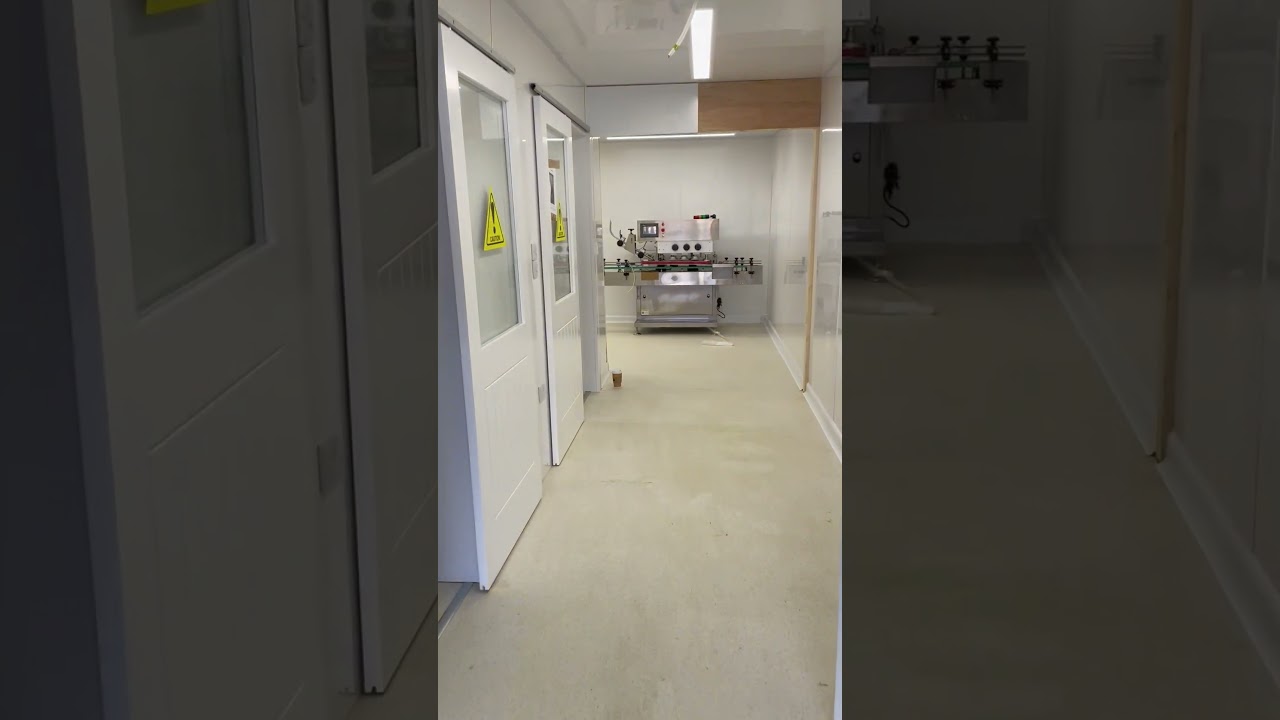
A short time-lapse of the Kidlington facility going up — the building, the kit, the production floor where every NF bottle now starts its life. No agency render, no stock B-roll, no licensing fee. Real walls, real concrete, real shelving.
Watch on YouTubeUS-based analytical lab specialising in nutraceutical, food-grade and pharmaceutical testing. Performs the bulk of our potency, identity and microbial work.
Global testing network and one of the most widely used third-party labs in food, pharma and supplement analysis. Used for cross-validation and confirmatory potency runs on cardiovascular actives.
Botanical identity specialists with the largest privately-held herbarium of its kind. The gold standard for confirming species, plant part and authenticity by HPTLC and microscopy.

From April 2026, every newly-printed bottle ships with a QR code on the label. Scan it. It opens that exact batch's lab certificate. No login, no email signup, no four-step navigation through a "transparency portal" that turns out to be a stock photo of a beaker and a paragraph about "our commitment to quality."
If your bottle hasn't got the QR code yet — most of the bottles in customers' hands today don't — your product is still tested. We've just got more bottles already in the world than we've got label updates in the print queue. The certificate is published. The batch number printed on the lid is the same key. The QR just saves you the typing.
Alongside running NF Supplements, our founder Logan publishes investigative supplement testing on YouTube under Logan Talks Health. Bottles are purchased from the open market — Amazon, retail shelves, named DTC brands — and sent to the same kind of ISO/IEC 17025 accredited laboratories we use on our own products.
The results, recorded across hundreds of tests, show a pattern that's hard to walk away from. Substandard isn't the exception in this industry. In many categories it's the default. The four case files below are a representative sample of what came back from the labs — and the reason our own batches go through the system documented on this page.
These weren't fringe brands. They were products with marketing budgets, retailer listings, and tens of thousands of glowing reviews. Which is why every single one of our own batches goes through the system documented on this page — and why we publish the results regardless of what they show.
Watch the investigations|
NF Supplements
Lab-tested · UK made
|
Most Supplement Brands
Outsourced · Untested
|
|
|---|---|---|
| Independent ISO/IEC 17025 lab on every batch | ||
| Certificates published openly, unredacted | ||
| In-house GMP manufacturing (no contract manufacturer) | Outsourced to China | |
| Batch number on the bottle indexes the certificate | ||
| Competitor products tested against the same standard | ||
| Failed batches recorded and disclosed | ||
| Verdict | Full transparency | Take it on faith |
ISO/IEC 17025 is the international standard that defines the requirements for the competence of testing and calibration laboratories. A lab carrying this accreditation has been independently audited on its methods, equipment calibration, staff competence, and quality systems. In the UK this accreditation is administered by UKAS. It is the standard regulators, courts and pharmaceutical companies rely on when a result has to be defensible.
SORA Laboratories, Eurofins Scientific, and Alkemist Labs all hold ISO/IEC 17025 accreditation for the methods we use across our product range.
Every NF Supplements product is manufactured in our own GMP-certified facility in Kidlington, Oxfordshire (OX5 1FQ). We own the building, run the production lines, and employ the quality team that signs off every batch.
There is no contract manufacturer in the UK, no facility in China, no third-party site we don't control. When we say "we made it," we mean we made it — under one roof, one quality system, one set of keys.
Both. Every raw ingredient arrives at our facility with an independent third-party Certificate of Analysis from the supplier — confirming the species, the chemical form, and the stated potency before we accept it through goods-in.
Then after manufacturing, we pull one or two finished bottles directly off the packing line and send them ourselves to an ISO/IEC 17025 accredited laboratory. Two independent tests, two checkpoints, between the supplier shipment and the bottle in your hand. The finished-product certificate is the one that gets published to testing.nfsupplements.co.uk.
Because sampling occasionally doesn't catch the batches you didn't sample. A raw material that drifts mid-shipment, a piece of equipment that goes slightly out of calibration, a contamination event that affects one production run — none of those will show up in a quarterly spot-check.
Testing every batch is the only way to actually know what's in the bottle you just shipped. It's also why most brands don't do it: the per-bottle cost is meaningfully higher, and publishing the result openly carries real financial risk if something ever falls short.
Because they don't have to, and because it's expensive. Independent testing on every batch — across the full assay panel — adds meaningful cost per bottle. Brands relying on a contract manufacturer also typically accept the manufacturer's in-house Certificate of Conformity in lieu of independent testing, which costs them nothing extra.
Publishing the certificates publicly carries an additional risk: if a batch ever falls short, you can't quietly bury the result. We accept that trade-off. The cost of being held to it is, in our view, what the certificate is worth.
Yes. Every batch we have ever produced has been third-party lab tested and published to our public database. The QR code on the lid is a packaging update that started rolling out in April 2026 — bottles printed before that date don't carry it yet, but the underlying testing system is unchanged.
You can still verify your batch the manual way: type the batch number printed on the lid into testing.nfsupplements.co.uk and the certificate will come up. The QR just saves you the typing.
From the moment the finished bottle comes off the packing line to the certificate being uploaded usually takes 7–14 working days. The bulk of that time is the lab's analytical work — running the assays, peer-reviewing the results, and issuing the formal Certificate of Analysis.
Once the certificate lands with us, the PDF goes straight to testing.nfsupplements.co.uk, indexed by batch number. We don't sit on certificates — good or bad.
The batch is held. Depending on the failure mode and the assay involved, the batch is either reworked under documented procedure, retested, or destroyed. The decision is recorded against the batch in our quality system, and that record exists whether or not the batch eventually ships.
We have rejected our own production on this basis. It is a real cost line in the business, and a real reason we manufacture in-house — when you control the facility, holding a batch is a quality decision; when you don't, it's a contract dispute.
Yes. Each Certificate of Analysis carries the issuing laboratory's name, accreditation number, contact details, and a unique report reference. Anyone — a journalist, a regulator, a clinician, a customer — can contact the lab directly with that reference and confirm the report was issued by them.
This is the test that separates a real third-party certificate from a marketing graphic. If the lab can't confirm the report when you call them, the certificate isn't worth the paper it's printed on.
Yes — and we publish those results too. We periodically purchase competitor products from the open market and submit them to the same independent labs under blind reference. Where the result is materially different from the label claim we publish the assay alongside our own, with the lab reference and the methodology used.
We treat this as a legitimate part of the public record. If our standards mean anything, they have to be applied consistently — to our own batches and to the products our customers are otherwise being asked to swallow.
Most supplement brands ask you to trust the label and hope for the best. We hand you the lab certificate, the batch number printed on the lid, and the keys to verify the bottle yourself.


